
The map of the Negev’s Bedouin villages, now in Arabic, Hebrew and English
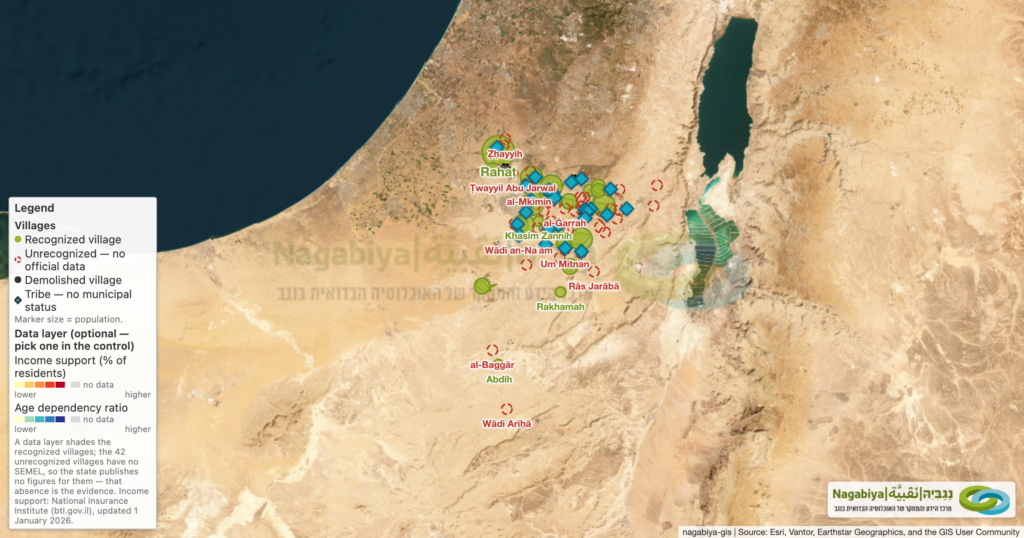
Our interactive map of the Negev’s Bedouin villages now comes in three editions, Arabic, Hebrew and English, each wholly in its language. It shows the 21 recognized towns and villages, the 42 unrecognized villages and the 2 that were demolished, and the 25 tribes the state counts but denies municipal status. Recognized villages show official […]
Where to vote: a map of the polling stations in the Negev’s Bedouin localities
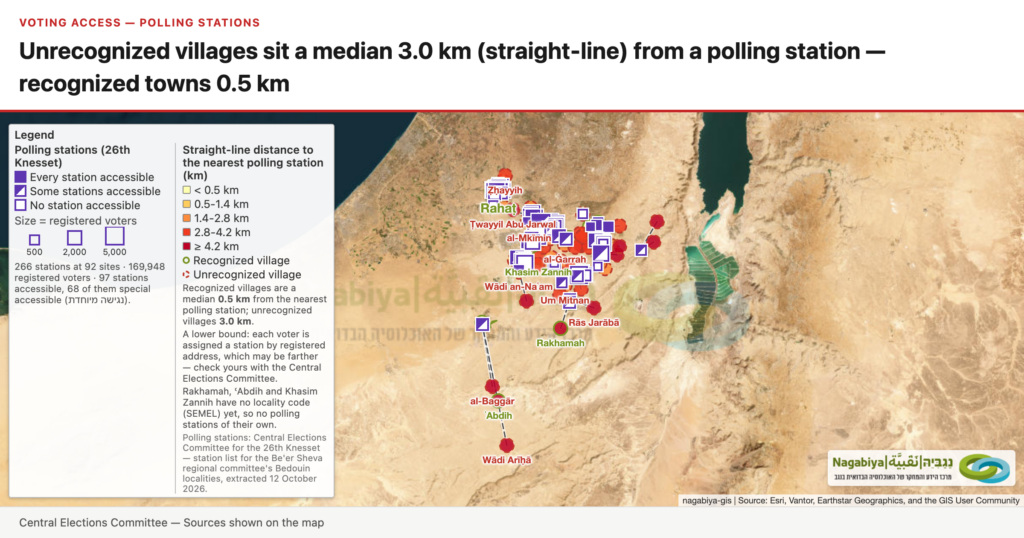
Ahead of the Knesset election on Tuesday, 27 October 2026, we mapped the polling stations the Central Elections Committee has set up in the Negev’s Bedouin localities: 266 stations at 92 sites, for 169,948 registered voters. The map shows each polling site, how many stations it holds and whether they are accessible to people with […]
Statistical Yearbook of Bedouin Society 2012-2023

The Statistical Yearbook of Bedouin Society in the Negev is dedicated to reporting and documenting the characteristics of the Bedouin population in the Negev and the changes occurring within this population over time. The goal of the yearbook is to reflect an up-to-date picture of Bedouin society in the Negev in order to make it […]
NEET (Not in Education, Employment, or Training) in the Bedouin Community in the Negev/Naqab – A Critical Perspective

The recently published State Comptroller’s report on idle Arab youth points to the far-reaching consequences of this phenomenon not only for the Arab public but also for Israeli society as a whole. The report highlights the urgency of addressing idle youth in the Bedouin community, in which their proportion is higher compared to other groups […]
Discrimination in numbers – statistical data concerning the Bedouin community in the Negev/Naqab

The data in this file is based on data from the Israeli Central Bureau of Statistics, data published by Government ministries, and on data from various official authorities. The data presented in the file are focused on a number of fields – population estimates, communities in the Negev/Naqab, and data concerning education, training, wages and […]
Damage to Employment, Protection, and Sense of Security among Women in the Negev Bedouin Communities, in the Shadow of the War between Israel and the Hamas

This study was written as a result of the war that broke out between Israel and Hamas in October 2023. The research focused on the ramifications of the war in terms of the aspects of protection, security and employment of Bedouin women in the Negev. It is based on an online survey that was undertaken […]
Bedouin women’s employment in the Negev in the shadow of the Corona crisis

This paper relates to the employment situation of Bedouin women in the Negev/Naqab in the shadow of the Corona crisis. The document shows that as a result of the Corona crisis, there has been a serious setback in the employment rates of Bedouin Arab women in the Negev, causing their employment situation to deteriorate, and […]
Employment of Arab Women in the Negev

This report deals with occupational trends among Bedouin women in the Negev. The report shows that the employment rates of Bedouin Arab women in the Negev are very low over time. The low employment rates among Bedouin women are related to various fundamental factors, including development disparities between peripheral and central populations, disparities and discrimination […]
The Ramifications of the Israel-Hamas War on the Employment and Economic Security of Bedouin Society in the Negev

Against the background of the war that broke out between Israel and Hamas on October 7, 2023, we conducted a study that combines administrative data processing with an online survey in order to examine the economic and employment consequences of the war on the residents of the recognized and unrecognized Bedouin villages in the Negev/Naqab. […]
Is the “Employment Circles” program suitable for Bedouin women in the unrecognized villages in the Negev

The report is based on a study conducted among 30 Bedouin women, most of whom are residents of unrecognized villages in the Negev/Naqab, who participate in the “Employment Circles” program conducted by the Israeli Employment Services under the auspices of the Ministry of Economy and Industry. The goal of the program is the prevention of […]